A bathroom can look clean and still smell musty. That does not automatically mean there is extensive mould behind the walls, but it does mean moisture is lingering somewhere long enough to create an odour.
The source may be as simple as a damp bath mat, shower curtain, or cabinet. It may also involve recurring humidity, a failed seal, a leak, or concealed mould. Cleaning alone cannot resolve the problem when the material producing the smell stays wet or keeps getting wet.
The useful question is not only what the bathroom smells like. It is where the smell is strongest, when it returns, and whether other moisture signs are present.
What a musty smell can tell you
A musty or earthy odour is commonly associated with damp materials and mould growth, including mould that is not yet visible. The smell is evidence worth taking seriously, but it is not a diagnosis. It cannot identify the material involved, the size of the affected area, or the moisture source.
Bathrooms create warm, humid air quickly. If that moisture does not clear, it can remain on colder surfaces or be absorbed by textiles, grout, drywall, cabinetry, and dust. Water from a leaking fixture, plumbing connection, exterior source, or failed joint can create the same damp conditions from another direction.
This is why a returning smell should be traced rather than assigned immediately to the fan or silicone.
Start by narrowing the location
Remove washable items such as the bath mat, towels, hamper contents, and fabric shower curtain. Wash and dry them completely, then let the bathroom dry with the door open. If the odour clears and stays away, the source may have been a removable material that was staying damp.
If the smell remains, note where it is strongest. An odour concentrated around a tub edge, shower base, or countertop joint may justify a closer look at the silicone. A smell strongest inside or beneath a vanity may point to damp cabinetry, a plumbing leak, or stored materials. An odour that seems to come from a drain, changes when water runs, or resembles sewage rather than damp earth belongs with a plumber.
A diffuse smell that becomes stronger after showers, together with lingering condensation, suggests the room is not drying effectively. Ventilation may be part of that condition, although a fan running at the ceiling does not by itself prove that enough air is leaving the room.
What to look for around the room
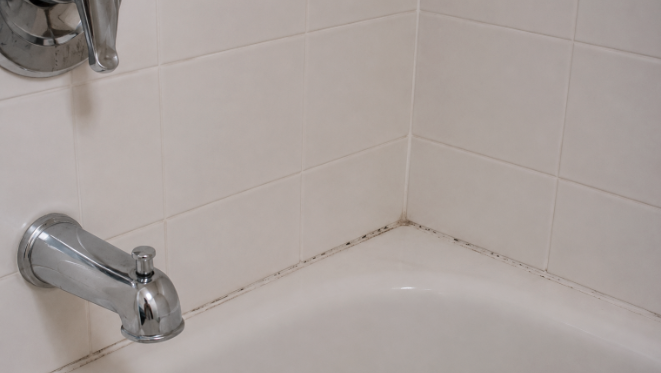
Inspect visible surfaces without opening walls or pressing into weakened materials. Look for silicone that has separated at an edge, dark growth that returns after cleaning, staining beneath plumbing, peeling or bubbling paint, swollen cabinet material, soft drywall, or condensation that remains long after bathing.
You can hold a light piece of tissue against the fan grille while it runs. If it stays in place, the grille is drawing air. If it falls away, suction may be weak or absent. This test does not measure airflow, confirm that the duct is clear, or prove that the fan is adequate for the room.
The timing matters as much as the appearance. A smell that appears only after showers points toward a drying problem. A constant odour near one fixture or cabinet suggests a more localized source. A strong smell with no visible explanation may require investigation for concealed moisture or mould.
Where does the condition sit?
The smell clears after damp textiles are removed and the room dries. There is no recurring growth, staining, soft material, leaking fixture, or failed joint. Clean and dry the removable items, improve the room’s drying routine, and monitor for a return.
The smell returns after showers or is strongest near a visible joint. Condensation lingers, the fan appears to draw weakly, or silicone is cracked, separated, or repeatedly discoloured. The ventilation and the affected joint can be assessed before the condition spreads to surrounding materials.
The smell is strong or constant and comes with a leak, soft drywall, swollen cabinetry, widespread visible mould, loose materials, or unexplained staining. The source may be concealed or extend beyond the fan and silicone. Plumbing, building-envelope, mould-remediation, or material-repair expertise may be required before surface work begins.
What not to do first
Do not cover the smell with fragrance and treat its disappearance as proof that the condition is resolved. Odour control does not dry a material or stop a leak.
Do not apply new silicone over an old, damp, dirty, or mouldy joint. The existing material must be removed and the joint prepared and dried before a new seal can adhere properly.
Do not assume bleach is the required answer. Small amounts of mould on suitable hard surfaces can generally be cleaned with detergent and water, followed by complete drying. Porous materials that have become mouldy may not be recoverable through surface cleaning alone. Never mix cleaning products.
Most importantly, do not keep cleaning the same returning growth without addressing why the area remains damp.
Where Emmassa’s scope begins and ends
Emmassa can assess whether the bathroom fan fits a contained replacement and whether failed silicone at a tub, shower, or countertop should be removed and resealed. These are visible, defined maintenance conditions that can contribute to a bathroom remaining damp.
A musty smell does not automatically place the problem within either service. When the signs point to plumbing, roofing, exterior water entry, concealed mould, damaged drywall, swollen cabinetry, or remediation beyond a contained joint, that boundary should be established before fan or silicone work proceeds.
The goal is not to make the smell sound more serious than it is. It is to find the moisture condition that allows it to return, then direct the work to the right place.