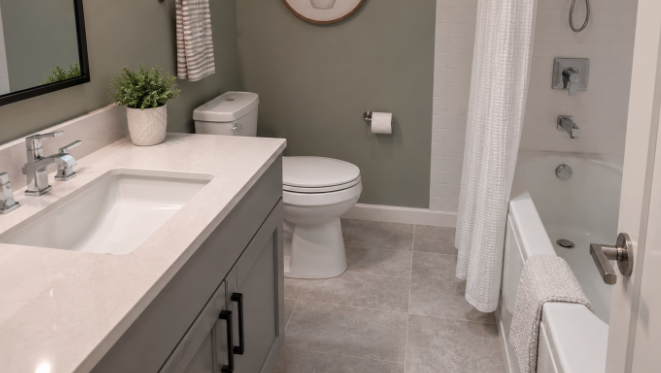
Bathroom problems rarely begin with a dramatic event. More often, a seal starts to separate, condensation lingers longer than it used to, paint loses adhesion, or the base of a vanity begins to swell. None of those signs identifies the cause by itself, but each one is easier to deal with when it is noticed early.
This check is not a substitute for a building assessment, and it cannot reveal what is concealed behind a wall or ceiling. It gives you a consistent way to notice change, record what you see, and decide whether the condition can be monitored or deserves a closer look.
There is no universal inspection interval for every bathroom. A twice-yearly check is a practical starting rhythm, with an extra look whenever the room begins drying differently, develops an odour, or shows a new mark.
1. Notice how the room dries
The exhaust fan helps remove moisture, but sound alone does not show how well the room is ventilating. What matters is whether the room returns toward normal after bathing and whether that pattern has changed.
Air movement at the grille. A light piece of tissue held against the grille can show whether air is being drawn into the opening. It does not measure airflow or prove the fan is adequate for the room.
A change in sound. New rattling, grinding, scraping, or vibration deserves attention. A fan that has always been loud may still be moving air, while a quieter fan may still be underperforming.
The room after bathing. Watch whether visible condensation begins to decline or remains on the mirror, ceiling, and upper walls. There is no single clearing time that applies to every bathroom, so compare the room with its usual pattern.
When to actAssessment is reasonable when suction at the grille appears weak, the sound has changed, condensation is lingering more than usual, or moisture signs are appearing elsewhere in the room. Applicable ventilation requirements depend on the building, system, jurisdiction, and work being undertaken, so one airflow number should not be treated as a universal rule.
2. Follow the silicone joints
Silicone is used where materials meet and water needs to remain at the surface. The most useful check is not whether the bead still looks white from a distance. It is whether the seal remains attached and continuous along the joint.
Adhesion. Look for an edge lifting away from the tub, shower base, tile, counter, or wall. Even a small separation means the joint is no longer fully sealed at that point.
Continuity. Follow the complete bead for splits, missing sections, thinning, or places where the silicone has pulled apart.
Condition. Discolouration may be on the surface or within the silicone. Material that is brittle, cracked, loose, or repeatedly discoloured after cleaning deserves closer attention.
When to actA separated or cracked seal should be assessed before more water is directed at the joint. New silicone should not simply be placed over failed material. The old seal, substrate condition, cleaning, drying, and joint preparation all affect whether the replacement will hold.
3. Look up before repairing the surface
Ceilings and upper walls can show the effects of room humidity, a leak from above, plumbing, roof or exterior water entry, condensation around ducting, drywall movement, or an earlier repair. The location of a mark helps, but it does not prove the source.
Paint changes. Watch for peeling, bubbling, flaking, or areas where the finish has begun to release from the surface.
Staining. Yellow, brown, grey, or expanding marks may indicate moisture has reached the surface. Note whether the mark changes after bathing, rainfall, or use of plumbing above.
Cracks and movement. A fine, dry seam crack may be cosmetic. A crack that is widening, returning after repair, or appearing beside staining, softness, or sagging deserves assessment.
When to actDo not start by filling or repainting an area that is wet, stained, soft, sagging, or changing. The source should be understood first. Avoid pressing firmly into weakened material or opening the ceiling without knowing what is above it.
4. Check the vanity area, not only the visible seal
Water around a basin or countertop can enter through a failed joint, a loose fitting, a plumbing connection, or repeated splashing. The cabinet often shows the consequence before the source is obvious.
The countertop joints. Check the silicone where the basin meets the counter and where the counter meets the wall.
The cabinet base and sides. Look for swelling, staining, delamination, dampness, or a musty odour.
The plumbing connections. Without loosening anything, look for droplets, mineral deposits, corrosion, or a wet area below a connection.
When to actA failed silicone joint may fit contained resealing work. Active plumbing leakage, damaged cabinetry, or moisture entering from an uncertain source requires the appropriate trade or further investigation.
Read combinations, not isolated signs
One sign often leaves several possibilities open. Combinations provide better direction. Weak suction at the fan grille, condensation that now lingers, and peeling ceiling paint together make a ventilation or moisture assessment more useful than any one observation alone. A lifted shower seal beside staining or softened material means the surrounding condition matters as much as replacing the silicone.
Patterns can guide the next step, but they should not be turned into certainty. A ceiling stain does not prove the fan caused it. A musty cabinet does not prove the countertop seal failed. Record what changed, where it appears, and what seems to make it better or worse.
What to do with what you find
The condition is dry, stable, and isolated. Photograph it, note the date, keep the area dry, and compare it during the next check.
A seal is separating, the fan has changed, condensation is lingering, or a mark is recurring. The source may still fit contained maintenance, but it should be assessed before surface repair or repeated cleaning hides the pattern.
There is active leakage, soft or sagging material, widespread mould, damaged cabinetry, significant movement, or an uncertain concealed source. The condition has moved beyond a simple fan or silicone decision and belongs with the appropriate building professional.
Where Emmassa’s scope begins and ends
Emmassa can assess whether a bathroom fan replacement or silicone reseal fits the visible condition. That includes looking at the fan, accessible airflow observations, and the relevant silicone joints before defining a contained scope.
Plumbing leaks, roofing or exterior water entry, structural movement, concealed moisture investigation, mould remediation, drywall replacement, and damaged cabinetry are outside that contained scope. When the evidence points there, the right result is a clear boundary and the appropriate referral, not a fan or resealing job forced onto a different problem.